

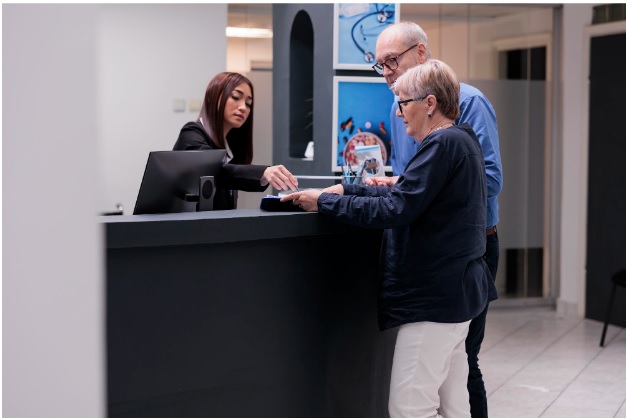
If you’ve been working at a doctor’s office as a receptionist, then you already have decent experience in scheduling appointments, welcoming patients, and, more importantly, you know how a clinic functions.
While your experience at the front desk is an incredible asset, it is usually only half of the equation. The reality is that if you want to advance in your career and move towards a medical assistant role, you need offline or online medical assisting courses, as there is a reason why receptionists aren’t considered MAs.
This blog will help you understand why you need to experience and how you can bridge the skill gap.
Understanding the difference between the Front Office and the Back Office
To understand why training is necessary, we have to look at both the front office tasks (which you might already be familiar with) and back office duties.
The Front Office (Your Current Strength)
- Patient Check-in/Check-out: Managing the first and last impression.
- Insurance Coordination: Ensuring the clinic gets paid.
- HIPAA Compliance: Keeping patient files secure.
- Telephony: Routing calls and managing physician schedules.
The Back Office
- Clinical Procedures: Drawing blood (phlebotomy), performing EKGs, and administering injections.
- Patient Triage: Taking vitals (blood pressure, pulse, temperature) and recording medical histories.
- Assisting the Physician: Helping with minor surgical procedures or specialized exams.
- Pharmacology: Understanding medication dosages and safety protocols.
Learn Why Receptionist Experience Alone Isn’t Enough
While you might have observed these clinical tasks from the front desk, observation is not the same as competency. Here are three primary reasons why formal training is essential for a receptionist looking to level up.
1. Patient Safety and Legal Liability
In the front office, a mistake usually results in a scheduling error or a billing headache. In the back office, a mistake can result in patient harm. If you administer a vaccine at the wrong dosage or fail to spot a dangerously high blood pressure reading, the consequences are severe. Because of this, healthcare providers and their insurance carriers almost always require MAs to have formal training and certification to mitigate risk.
2. National Certification Requirements
In today’s job market, most reputable hospitals and clinics require their medical assistants to be certified (CMA or CCMA). To sit for these national exams, you typically must provide proof that you have completed a program from an accredited institution. Your years of experience at the front desk, while valuable, generally do not qualify you to take the certification exam on their own.
3. The “Why” Behind the “How”
You might know how to put a blood pressure cuff on a patient, but do you know why the diastolic reading is as important as the systolic? Do you know the contraindications for certain medications? Formal online medical assisting courses provide the scientific foundation—anatomy, physiology, and pharmacology—that allows you to think critically in a medical setting.
How to Bridge the Skill Gap
Here you have two options: either you can ask your employer to train you OR you can enroll in a high-quality medical assistant training course by reputable providers like CCI Training Center.
It is highly recommended that you opt for the second option, as it will help you understand everything in detail and have a better understanding of the MA role.
During your training program, you can expect the following:
- Phlebotomy and Lab Procedures: Learning how to safely draw, process, and test blood samples.
- Vital Signs and Physical Exams: Mastering the tools used to assess patient health accurately.
- Specialized Procedures: Learning how to perform EKGs, vision tests, and pulmonary function tests.
- Pharmacology and Injections: Understanding the math behind dosages and the technique for safe injections.
NOTE: The training course will still teach you administrative tasks.