

Introduced by American biochemist Kary Mullis in 1983, Polymerase Chain Reaction (PCR) is a laboratory nucleic acid amplification technique widely used in molecular biology to make several copies of a specific DNA sample, such as blood, skin, hair, saliva, and microbes.
This allows scientists and researchers to amplify a very small sample of DNA, which makes analysis, diagnostics and experimentation easier. This technique is widely used in:
- Medical diagnostics
- Forensics
- Genetic engineering
- Biological researc
PCR involves using short synthetic DNA fragments, known as primers, to choose a segment of the genome to be amplified and then multiple cycles of DNA synthesis to amplify that segment. Since multiple copies of DNA can be generated via PCR, it is known for its sensitivity.
To conduct PCR, you need the following components:
- Template DNA – the sample containing the DNA region to be copied
- Primers – short synthetic DNA fragments that initiate replication
- DNA polymerase – usually Taq polymerase, derived from Thermus aquatics
- Nucleotides (dNTPs) – the building blocks (A, T, C, G) for new DNA strands
- Buffer solution – maintains the pH and salt concentration
- Thermal cycler – a machine to control temperature cycles
Types of PCR
PCR is of the following types:
- Conventional PCR: This is the basic PCR method used to amplify a specific DNA sequence. It allows users to detect the final product using gel electrophoresis, usually stained with a dye like ethidium bromide.
- qPCR (quantitative PCR): This PCR helps DNA amplification in real time. It uses fluorescent dyes or probes that emit signal as DNA amplifies.
- RT-PCR (Reverse Transcription PCR): This type is used when RNA is used instead of DNA. In this technique, RNA is first reverse transcribed into complementary DNA (cDNA) using reverse transcription and then standard PCR is performed on cDNA.
- RT-qPCR: RT-qPCR or Reverse Transcription PCR with Quantitative PCR is used to quantify RNA levels in a sample. This is done by first converting the RNA into complementary DNA (cDNA) using reverse transcription. After this, the amplification of cDNA is done in real time using fluorescence detection.
- Multiplex PCR: In this technique, multiple sets of primers are used in a single reaction to amplify multiple DNAs at the same time.
- Nested PCR: This technique involves using two sets of primers in two successive PCR reactions. The first set amplifies a larger DNA fragment, whereas the second set amplified a smaller, internal target.
- Digital PCR: This is a new and highly sensitive technique that divides a DNA sample into multiple tiny reactions with each acting independently. Amplification occurs in every partition and the results are then statistically analyzed to count the exact number of DNA molecules.
- Hot-start PCR: In this, the DNA polymerase is inactivated at room temperature and only activated after the initial denaturation step at high temperatures. This is done to prevent non-specific amplification or primer-dimer formation during reaction setup.
Characteristics of PCR
- Sensitivity: PCR can detect and amplify even a single copy of DNA
- Specificity: PCR primers can help ensure only the targeted DNA region is amplified.
- Speed: PCR can be completed within a few hours.
- Versatility: PCR can work with a variety DNA sources and sample types.
- Quantification: Techniques like qPCR can provide results in real time.
Steps of PCR
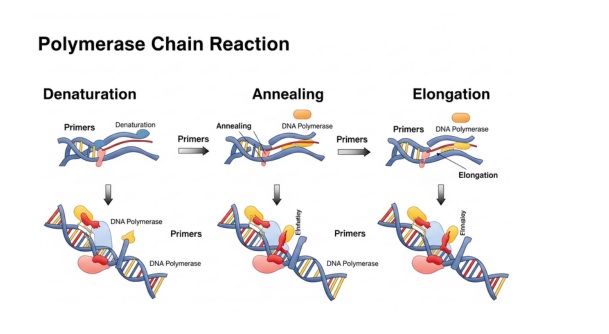
- Denaturation: Denaturation refers to the process of breaking the two strands of DNa into a single stranded DNA. This is done so that primers can access the target sequence.
- Annealing: Annealing is used to bind primers to their complementary sequences on the single stranded DNA template. Primers serve as the starting point for the DNA synthesis.
- Elongation: DNA polymerase synthesizes new DNA strands by adding nucleotides to the primers. This helps extend the DNA sequence.
Applications of PCR Kits
Polymerase Chain Reaction kits are used for several applications, including:
- Medical Diagnostics
- Genetic Research
- Forensics
- Agricultural and Food Safety
- Environmental Monitoring
The Bottom Line
Polymerase Chain Reaction (PCR) is a cornerstone of modern molecular biology. From its inception in the early 1980s to its current use in cutting-edge diagnostics and research, PCR continues to evolve. With advancements like qPCR and qRT-PCR, scientists can now quantify and analyze DNA and RNA with exceptional accuracy and speed.
As a powerful and indispensable tool, PCR has transformed our ability to explore, understand, and manipulate genetic material, paving the way for innovations in healthcare, science, and beyond.